Courses

Basic English Course 1

Unit 1: All About You

Learn how to greet people, introduce yourself, use the verb to be, spell names and emails, give numbers, and ask for basic personal information.

Sessions 1-3American EnglishPersonal informationVerb to be
Unit Route

Unit 1 is the foundation of the course. Students first learn social language, then identity sentences with to be, then spelling, numbers, and personal information questions. All the subtopics work together so students can introduce themselves clearly.

What you will learn

I can greet people politely.
I can say my name and age.
I can use am, is, and are.
I can spell names and emails.
I can say phone and ID numbers.
I can ask basic personal information questions.
StartGreetingHello. / Good morning.
NameIdentityMy name is Ana.
GrammarTo beI am a student.
OriginFromI am from Colombia.
Exact infoSpellingA-N-A.
ContactNumbers300 555 2841.
EndClosingNice to meet you.
01

Greetings, Polite Answers, and Farewells

Students learn the social frame of a first conversation: say hello, ask how the other person is, respond politely, and close the interaction.

Teacher welcoming an adult English student on the first day of class

Real context: first contact

Students use Unit 1 language when they arrive to class, meet a teacher, register their information, or introduce themselves to a new classmate. The language must be short, polite, and clear.

Greeting + name + polite answer + farewell

Formal and neutral greetings

Good morning.Use before noon.
Good afternoon.Use after noon.
Good evening.Use when you arrive at night.
Hello.Safe in almost every situation.

Informal and classroom language

Hi.Friendly and common.
How are you?Ask politely after greeting.
I am fine, thank you. And you?A complete beginner answer.
Goodbye. / Bye.Use when you leave.
Important: Good night is usually a farewell, not a greeting. When you arrive somewhere at night, say Good evening.

Formal / neutral

Good morning. / Hello. / Nice to meet you.

Use these with teachers, new classmates, and people you do not know well.

Informal

Hi. / Bye. / See you later.

Use these with friends, close classmates, and relaxed conversations.

02

The Verb To Be Inside Unit 1

The verb to be is not an isolated grammar page here. It is the engine students need to say who they are, where they are from, how old they are, and how they feel.

I am

Use I am to talk about yourself.

I am David. I am twenty years old. I am from Colombia.

He / She / It is

Use is for one person, one thing, or one place.

She is Ana. He is from Medellín. It is my email.

You / We / They are

Use are with you and plural subjects.

You are my classmate. We are students. They are in class.
FunctionStructureExampleSpanish idea
Name / identitySubject + be + nameMy name is Laura. / I am Laura.ser / llamarse
AgeSubject + be + ageI am twenty-one years old.tener años, but in English use be
OriginSubject + be + from + placeShe is from Envigado.ser de
FeelingSubject + be + adjectiveI am fine. He is happy.estar

Affirmative form

Use the subject first, then the correct form of be.

I am Ana. She is my teacher. They are classmates.

Contractions

Contractions sound natural in speaking and informal writing.

I am → I'm You are → You're He is / She is → He's / She's

Negative form

Use not after the verb be.

I am not from Bogotá. She is not my classmate. They are not in class.

Yes / No questions

Move am / is / are before the subject.

Are you a student?Yes, I am. / No, I am not.
Is she from Colombia?Yes, she is. / No, she is not.
Are they classmates?Yes, they are. / No, they are not.

Information questions

Use a question word first, then be, then the subject.

What is your name?My name is Laura.
Where are you from?I am from Colombia.
How old are you?I am twenty-one years old.
Common Mistake

In English we say I am 21 years old, not I have 21 years. Age uses the verb to be.

Audio model: introducing myself

Listen to a professional American English model. This audio connects the verb to be with name, age, city, and a short introduction.

03

Personal Information

Students learn how to give basic information in complete, short sentences. This prepares them for registration forms, first-day conversations, and short oral introductions.

Adult English student giving personal information in class

Real context: forms and introductions

Personal information is not only grammar. Students need it to complete forms, speak to a teacher, introduce themselves, and confirm contact information clearly.

My name is + age + city + phone number + email

Information to give

My name is Daniel.Name.
My last name is Rivera.Last name.
I am twenty-two years old.Age.
I am from Medellín.City or origin.
My phone number is 300 555 2841.Contact information.
My email is daniel.rivera@example.com.Email address.

Classroom model

Hello. My name is Daniel Rivera. I am twenty-two years old. I am from Medellín, but I live in Envigado. My phone number is 300 555 2841. My email is daniel.rivera@example.com. Nice to meet you.

Greeting + name + age + city + contact + closing
First namenombreMy first name is Ana.
Last nameapellidoMy last name is Gómez.
Full namenombre completoMy full name is Ana Gómez Pérez.
NicknameapodoMy nickname is Ani.
Colombian context: many students have two first names and two last names. In English, first name usually means the given name, and last name usually means the family name used in the form.
04

Alphabet, Spelling, and Emails

Students need the alphabet immediately because personal information often includes names, last names, emails, usernames, and document numbers.

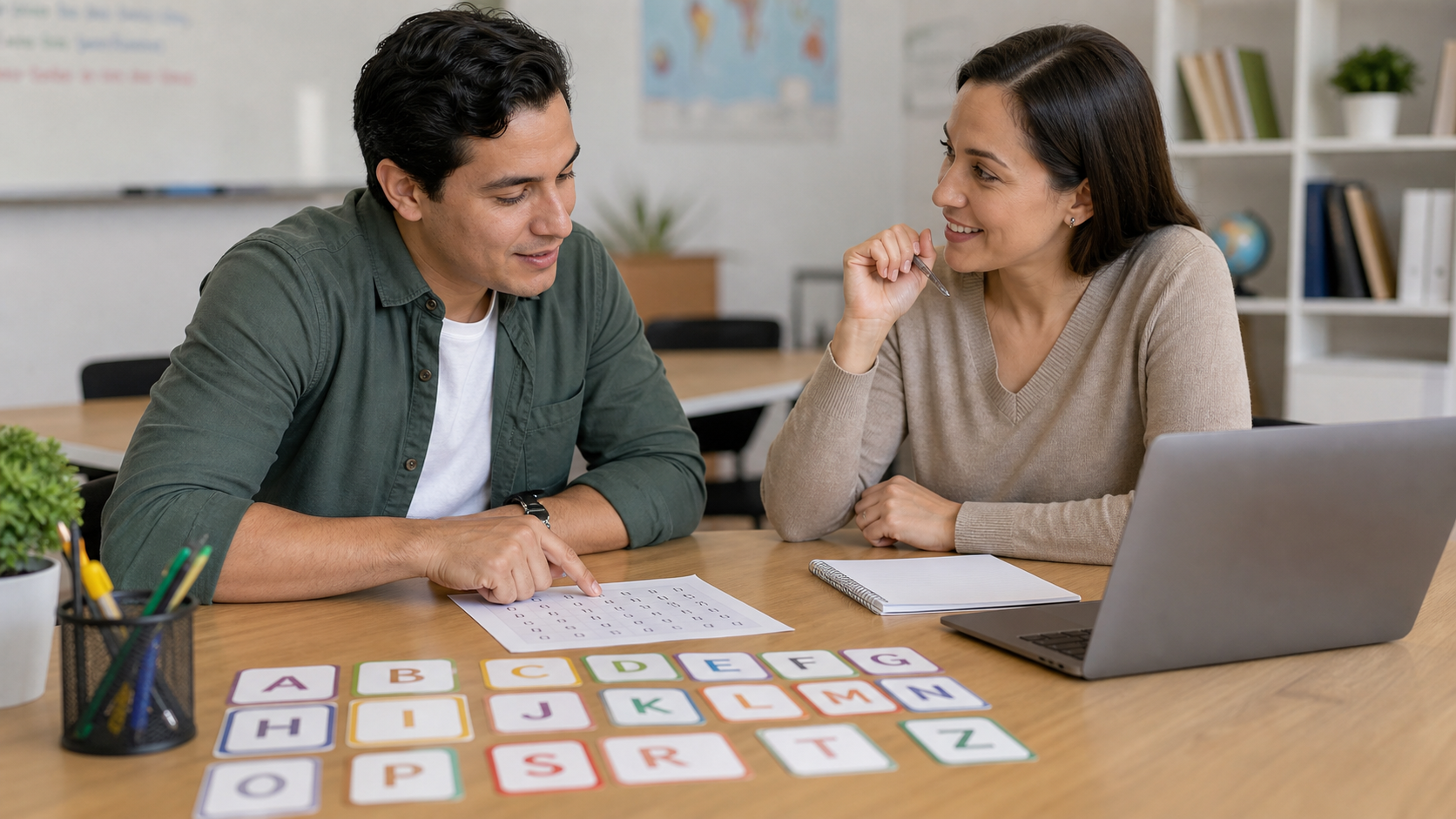
Adult English learner practicing alphabet and spelling with a teacher

Real context: exact information

Spelling is necessary when the listener needs the exact letters of a name, last name, username, or email address. In Unit 1, spelling supports personal information.

How do you spell your last name? → R-I-V-E-R-A
NamesHow do you spell your name?

Use this when the listener needs exact letters.

A-L-E-X
Last namesCould you spell your last name?

This sounds polite in registration contexts.

R-I-V-E-R-A
EmailsSymbols matter

Students must recognize at, dot, underscore, and hyphen.

name dot last at email dot com
letterspellcapital letterlowercaseatdotunderscorehyphenemailusername

Email and username symbols

@ = atana at email dot com
. = dotgmail dot com
- = hyphen / dashana hyphen gomez
_ = underscoreana underscore gomez

Difficult letters for Spanish speakers

A / E / IThese vowels are often confused.
B / VEnglish separates these sounds more clearly.
G / JThe letter names are different from Spanish.
Y / IY is a letter name; I is also a pronoun.

Audio model: letters and email symbols

Use these short professional clips to hear individual letters and symbols. They support pronunciation and exact spelling.

05

Numbers for Personal Information

In Unit 1, numbers are primarily functional: age, phone numbers, document numbers, classroom quantity, and basic forms.

Cardinal numbers

Use cardinal numbers to count and give exact information.

I am twenty-one.Age.
My phone number is 300 555 2841.Contact.
There are ten students.Quantity.

Ordinal numbers preview

Ordinal numbers are not the main focus of Unit 1, but students see them in course language and dates.

Unit 1Say: unit one. Use a cardinal number.
the first classUse an ordinal number for order.
AgeI am twenty-one years old.

Use be, not have, for age.

Phonethree zero zero / five five five / two eight four one

For phone numbers, say digits clearly, often in groups.

IDMy ID number is 45 459 231.

Document numbers must be slow and exact.

Common number contrasts

thirteen / thirty13 vs 30
fourteen / forty14 vs 40
fifteen / fifty15 vs 50

Zero in contact information

For phone numbers, people often say zero. In casual speech, some speakers also say oh, but zero is clearer for beginners.

300 = three zero zero

Audio model: numbers for contact information

Listen to individual number words used in phones, IDs, and basic forms.

06

Personal Information Questions

Students now combine greetings, to be, spelling, and numbers into useful questions for real interaction.

QuestionAnswer modelLanguage focus
What is your name?My name is Sara.name + be
What is your last name?My last name is Gómez.last name + be
How do you spell your last name?G-Ó-M-E-Z.alphabet
How old are you?I am twenty-two years old.age + be
Where are you from?I am from Colombia.from + place
What is your phone number?My phone number is 300 555 2841.numbers
What is your email?My email is sara@example.com.email spelling
Recommended study sequence: first understand the answers, then the questions, then the spelling. If students try to learn everything at once, the interaction becomes heavy for A1.
I have 20 years. ✕
I am 20 years old. ✓
My name Ana. ✕
My name is Ana. ✓
I am from in Medellín. ✕
I am from Medellín. ✓
How old you are? ✕
How old are you? ✓
Pedagogical focus: these corrections are not a test. They show the sentence patterns students must notice before speaking or writing personal information.
07

Integrated Model Dialogue

This model shows the complete Unit 1 package in action: greeting, name, age, city, spelling, and polite closing.

First day registration

Sara: Good morning. Welcome to English class. What is your name?

Alex: Good morning. My name is Alex Rivera.

Sara: Nice to meet you, Alex. How do you spell your last name?

Alex: R-I-V-E-R-A.

Sara: Thank you. How old are you?

Alex: I am twenty-one years old.

Sara: Where are you from?

Alex: I am from Medellín, but I live in Envigado.

Sara: Great. Have a nice class.

Alex: Thank you. Have a great day.

Step 1GreetGood morning.
Step 2IdentifyMy name is Alex.
Step 3SpellR-I-V-E-R-A.
Step 4CloseHave a great day.
08

Complete Self-Introduction Model

This final model puts the complete explanation together: greeting, name, age, origin, spelling, contact information, and closing.

Complete model

Hello. My name is Laura Gómez Pérez.

My first name is Laura, and my last name is Gómez.

I am twenty-one years old.

I am from Colombia, and I live in Medellín.

My phone number is 300 555 2841.

My email is laura dot gomez at email dot com.

Nice to meet you. Have a great day.

GreetingHello.Start politely.
IdentityMy name is...Use is.
AgeI am...Use am.
ContactMy phone number is...Say digits clearly.

Audio model: complete self-introduction

This professional American English audio gives students a natural rhythm for a short self-introduction.