Intermediate English · Unit 2
Unusual Experiences
In this lesson, students learn how to talk about unusual, surprising, scary, funny, or memorable experiences in English.
Students will also learn when to use the present perfect and when to use the simple past to explain experiences clearly.
Learning Outcome: To explain unusual experiences using the present perfect for life experiences and the simple past for specific details.
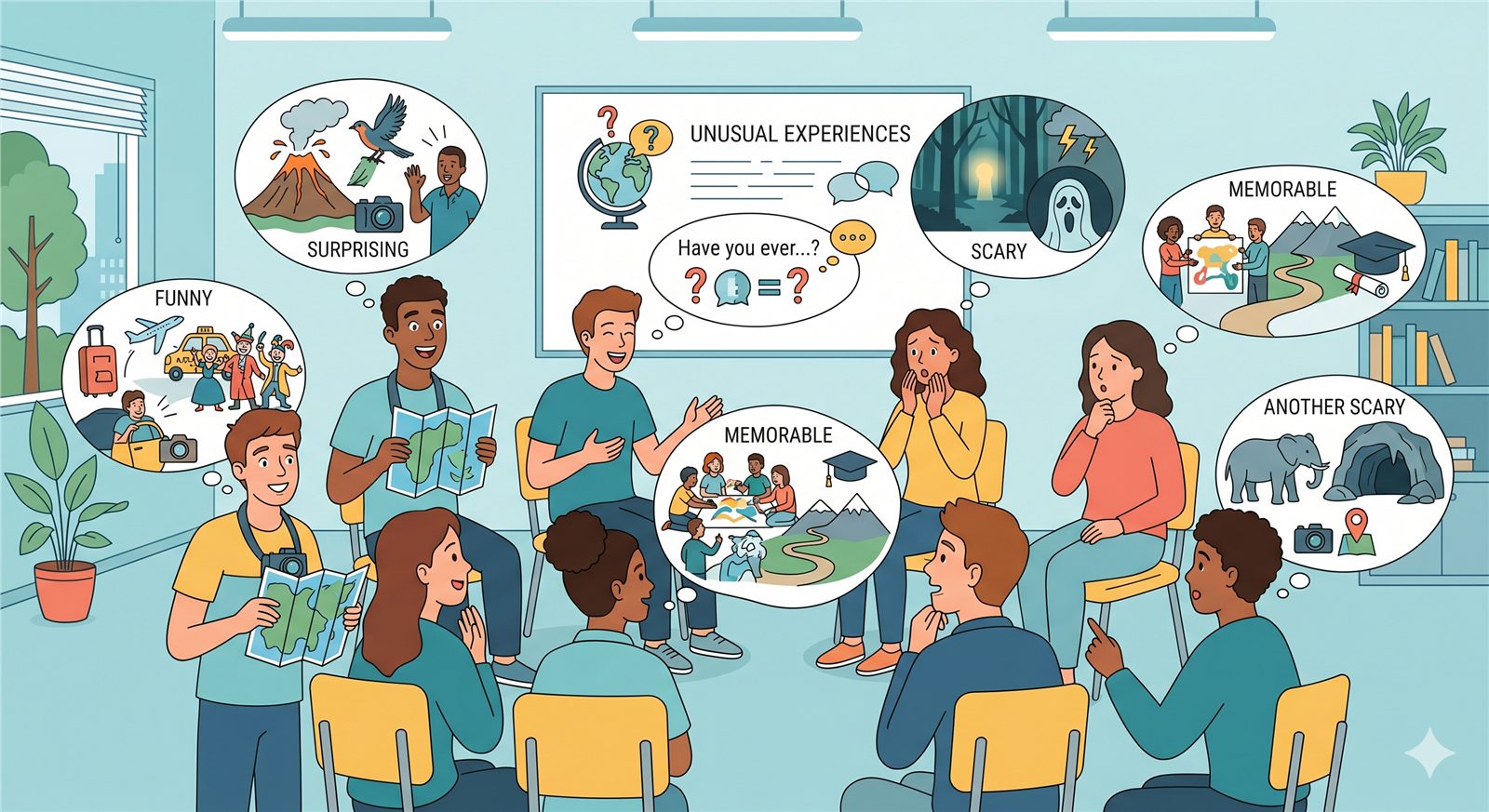
What is an unusual experience?
An unusual experience is something different from your normal life. It can be surprising, exciting, scary, funny, embarrassing, or memorable.
Exciting experiences
These are experiences that make you feel happy, energetic, or interested.
I have tried paintball. It was exciting and fun.Scary experiences
These are experiences that make you feel afraid, nervous, or uncomfortable.
I have never had a terrifying experience.Memorable experiences
These are experiences that you remember because they were special or different.
I have been to Europe. It was unforgettable.Present perfect for life experiences
We use the present perfect to talk about life experiences without saying exactly when they happened.
Structure
Subject + have / has + past participleUse have with I, you, we, and they. Use has with he, she, and it.
I have been to Europe. She has tried paintball.Common words
These words are often used when talking about life experiences:
ever · never · already · before · in my life Have you ever traveled alone? I have never slept in a tent.Simple past for specific details
We use the simple past when we say when the experience happened or when we give specific details about the event.
Structure
Subject + past verb + complementUse the simple past when the time is clear, finished, or specific.
I was in Spain last summer. We visited a museum in Madrid.Specific time expressions
Use the simple past with expressions such as:
yesterday · last summer · last year · two years ago · in 2023 · when I was a child I played paintball two years ago.Present perfect vs. simple past
We often start with the present perfect to introduce the experience. Then we use the simple past to give specific details.
| Purpose | Tense | Use | Example |
|---|---|---|---|
| Introduce the experience | Present perfect | Talk about something you have done in your life. | I have been to Europe. |
| Give specific details | Simple past | Say when, where, or how it happened. | I was in Spain last summer. |
| Describe the experience | Simple past | Explain how the experience was. | It was a great experience. |
| Talk about no experience | Present perfect | Say that something has not happened in your life. | I have never had a terrifying experience. |
Model sentence
I have been to Europe. I was in Spain last summer. It was a great experience.
Positive, negative, and question forms
These forms help students ask about experiences and answer with more detail.
Positive form
Subject + have / has + past participle I have been to Europe. She has tried an extreme sport.Negative form
Subject + have / has + never + past participle I have never had a terrifying experience. He has never traveled by plane.Question form
Have / Has + subject + ever + past participle? Have you ever had an unusual experience? Have you ever tried paintball?Short answers
Yes, I have. No, I haven’t. Yes, I have. I tried it last year. No, I haven’t, but I would like to.Useful language for explaining experiences
These expressions help students describe how an unusual experience felt.
Describe the experience
- It was exciting.
- It was scary.
- It was unforgettable.
- It was embarrassing.
- It was a great experience.
- It was one of the strangest moments of my life.
Describe your reaction
- I felt nervous at first.
- I felt surprised because...
- I didn’t expect it.
- I would like to do it again.
- I would never do it again.
- I still remember it because...
Example paragraphs
Notice how each paragraph starts with the present perfect and then uses the simple past to give details.
Example 1: Travel experience
I have been to Europe. I was in Spain last summer with my family. We visited Madrid and Barcelona, and it was a great experience. I tried different food, met friendly people, and took many pictures. I have always wanted to travel more, so this experience was very special for me.
Example 2: Strange experience
I have never had a terrifying experience, but I have had a strange one. One night, I heard a loud noise outside my house. I opened the window and saw a strange light in the sky. It disappeared quickly, and I never knew what it was.
Common mistakes
Remember: do not use the present perfect with a specific finished time expression like “last summer,” “yesterday,” or “two years ago.”
I have been to Europe last summer.
I have been to Europe.
I was in Europe last summer.
“Last summer” is a specific finished time, so we use the simple past: I was in Europe last summer.
Final reflection
This lesson prepares students to answer surveys, discuss popular experiences, and write about memorable moments later in Practice Lab.
Think about your life
Have you ever had an unusual experience? Was it funny, scary, exciting, or unforgettable? When you explain it, remember to introduce the experience with the present perfect and then give details with the simple past.